Showing posts with label german. Show all posts

Monday, November 24, 2008

Lubkuchen: Time to put that candied peel to work!

I don't know where I first had the thought to start baking lebkuchen. All I recall is that a few years ago I just had to bake them. It probably had something to do with my springerle fixation and wanting to become more versed in the Christmas baking of the Old World. Those Germans really know their sweets! ^_^

Well, regardless of where the impulse originated, I'm certainly glad it did, as these cookies are Christmas cookies incarnate! Plus they're made with the candied citrus peel I told you about yesterday! (double score!)
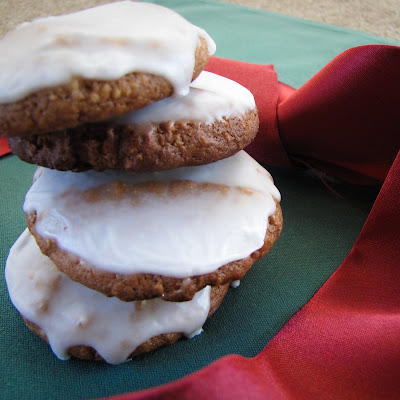


Lebkuchen are essentially a soft, German spice cookie (one among many). The base is a nut flour mixture, sweetened with honey and flavored with cinnamon, clove, ginger, and candied citrus peel. Originating in Franconia, Germany, the lebkuchen has had a place in traditional German Christmas celebration since the late 13th century. So the cookies have been around for over 700 years, they gotta be winners with that kind of record!

The recipe isn't hard, and is pretty straight forward. It is also fairly traditional from the sources I've looked at, and the lebkuchen I've tasted in the past. The only real part where I deviate from tradition is that in traditional lebkuchen, you place the cookie dough balls onto oblaten, a thin wafer cookie, which prevents them from cementing themselves to the pan. I've been unable to find small oblaten anywhere but online, and I'm not really keen on having to have them shipped every time I want lebkuchen. Thus I just bake mine on a parchment paper, which works beautifully. You could also do as the recipe suggests and use rice paper.

Lebkuchen
via Epicurious.com

For nut flour
3/4 cup hazelnuts (3 1/2 oz)
3/4 cup sliced almonds (2 1/2 oz)
2 3/4 cups all-purpose flour
3 tablespoons unsweetened cocoa powder
1 tablespoon ground cinnamon
1 teaspoon ground ginger
1/2 teaspoon ground cloves
3/4 teaspoon salt
1/2 teaspoon baking powder
1/4 teaspoon baking soda

For cookies
1 cup packed dark brown sugar
3/4 cup mild honey
1/2 stick (1/4 cup) unsalted butter, softened
2 large eggs
1/2 cup finely chopped fine-quality mixed candied fruit such as citron, orange, and lemon
4 (11 1/2- by 8 1/4-inch) sheets edible rice paper, cut with scissors into 32 (2 1/2-inch) rounds (optional)

For icing

2 cups confectioners sugar
3 tablespoons water

Make nut flour:
Finely grind nuts with remaining nut flour ingredients in a food processor.

Make dough:
Beat together brown sugar, honey, and butter in a large bowl with an electric mixer at medium-high speed until creamy. Add eggs 1 at a time, beating well after each addition. Mix in nut flour at low speed until just blended, then stir in candied fruit.

Preheat oven to 350°F.

Arrange rice-paper rounds, shiny sides down, on 2 large baking sheets. Roll level 2-tablespoon amounts of dough into balls with dampened hands, then put 1 on each paper round and flatten slightly (dough will spread to cover paper during baking).

Bake cookies in upper and lower thirds of oven, switching position of sheets halfway through baking, until surface no longer appears wet, about 15 minutes total. Transfer to racks to cool.

Ice cookies:
Sift confectioners sugar into a bowl, then stir in water until smooth. Evenly brush tops of cooled cookies with icing. Let icing set, about 1 hour.


Fröhliche Weihnachten!

Monday, September 17, 2007

Pre-holidays Springerle Test Run.

(Yes, I know, it's still too early for Christmasy stuff, but I wanted to give my new toy a spin.)

About this time last year, I became very interested in the art of springerle and other Old World Christmas cookies. At the time, however, I was unable to get any springerle molds and set my sights on the lebkuchen legacy (a blog to look for in coming months), and set aside my springerle dreams...until now.

I happened across the work Mr. Gene Wilson of Belleville, Illinois and his website, Hobi Cookie Molds. I looked about and almost immediately ordered my first hand carved springerle mold.


The molds features Weinachtsmann, one of what appear to be numerous variations of Santa in Germany. The mold is from Gene's Heirloom Springerle Collection, it measures three inches wide and five inches tall, and is 3/8 inch thick. The price was about even with most resin reproduction molds I've seen, at $26.

I am very impressed with the detail in the mold. The folds in Weinachtsmann's robe, the texture of the basket, the tree branches, even the three bags of coins...it's all there. But a mold is just a piece of kitchen decoration until one puts it to its intended use. So, I did.

The process of making springerle is pretty involved and requires a bit of planning. First, you have to let the dough rest and chill for two to three hours after mixing it. Second, after you do mold the cookies and cut them out, you have to let them dry on the counter for 12 to 24 hours. You then bake them "in a slow oven," which translates as 300º F, for 12 - 15 minutes. If that wasn't enough, after you cool them you need to let them "ripen" for a week (some recipes call for three weeks) in a container with a slice of bread. This lets you slowly reintroduce moisture into the cookies. Then you may enjoy.

I decided that I would use the included springerle recipe for my first try, and I'm fairly happy with the results.


They lack some of the finer details from the mold, but I guess you can't expect your first batch of springerle to be a blue ribbon entry. As you can see, they're quite puffy, which is a result I didn't see coming. Especially considering how flat and dense the dough was. When I broke one open (I couldn't help myself), the inside was almost cracker-like, with layers of air and cookie. Are they supposed to be like that?

I'll give them another try in a week or two, after my first batch ripens.

I'm already looking at the next molds I want to order from Mr. Wilson. This time I'm thinking...shortbread.

Sláinte!